Music
Film & TV
Music
Film & TV
13007 S. Western Avenue, Gardena, California 90249
Phone 310-836-1818 | Fax 310-742-0155
March 28, 2025
The only original, production-used Robot Model B-9 stunt figure from the Irwin Allen science fiction television series Lost in Space (20th Century Fox Television, 1965-1968). More freqently referred to in the context of the series simply as "the Robot", this Model B-9 figure is one of the most iconic in the history of sci-fi on the big or small screen.
The Robot is composed of three separate sections, including a plastic bubble sensor, a large trunk / torso section that includes sillicone arms, and a lower tread unit.
This fully restored B-9 robot is one of only two production-made full-scale figures that were used during the show's three year run. This iconic piece would have been utilized in scenes where a human operator would not have been possible because it was either too dangerous or not necessary.
This version of the character, used mainly for stunts and static scenes, appeared at many points during the third season of the series between 1967 and 1968. This stunt robot can be seen "floating" in space in the episode, "The Condemned of Space"; when the character is attacked by a Cyborg in the episode, "Space Destructors," in the episode "The Anti-Matter Man," when the stunt robot plays an alternate version of the storyline character in the same scene, and when the character is hanging upside down in a junkyard in the episode "Junkyard in Space."
The Robot was designed by Robert Kinoshita, who was also known for having designed Robby the Robot, the beloved droid from the science fiction film Forbidden Planet (Metro-Goldwyn-Mayer, 1956). After the initial pilot episode was released for Lost in Space, CBS executives suggested the addition of the Robot B-9 and Dr Zachary Smith (Jonathan Harris). After their inclusion, the series was immediately green-lit and would become an instant hit. Bob May provided the movement for the character in 82 episodes in the series, while Dick Tufeld voiced the character in 84 episodes.
After production had ended, the complete figure was saved from the backlot of Fox Studios and restored by special effects master Greg Jein, who painted B-9 and replaced component parts such as lighting elements and custom-built claws. It was during Jein's ownership that B-9 traveled around the world and was featured at various conventions and events.
The Robot had undergone a complete restoration nearly 20 years ago to bring the character back to its original condition during the time of production. Fred Barton, a B-9 restoration expert, stripped this stunt figure to its bare bones and preformed a ground-up restoration that included component fabrication, electrical wiring, an audio speaker system, neon illumination, new silicone arms to replace the decomposing rubber ones, new treads on the lower body, and much more.
Original pieces of the B-9 that were present during the production of Lost in Space include the collar, radar, Bubble lifter, fiberglass torso, fiberglass wrists, torso vents, bellows, connecting plate, knee sections, pedestals, and hinges. Upon powering on, The Robot comes to life with light bulbs present in the bubble section of his head, neon and light bulbs in the torso section, and an MP3 player with speakers that controls B-9's voice. This stunt robot has over seventy lines taken from the television show that it shuffles through, lighting up the neon in unison with the dialogue. The motor that rotates the figure's antenna and bubble lifter are currently non operational.
The back side of the robot's body has been signed by multiple members of the cast and crew during its travels to conventions and promotional events, including inscriptions from Mark Goddard (Major Don West), June Lockhart (Dr. Maureen Robinson), Bill Mumy (Will Robinson), Dick Tufeld (The Robot - Voice), Jonathan Harris (Dr. Zachary Smith), Lenwood Ballard "Bill" Abbott (Special Effects), Bob May (The Robot), and two unidentified signatures.
Bob May, who played the Robot on the series inscribed, "Love "N" Luck/ The Robot," and Dick Tufeld, who voiced the Robot with the famous line "Danger, Will Robinson!" wrote, " To Greg/ Who Always Computes!/ Best Wishes!"
Fred Barton reevaluated the B-9 again in preparation for this auction.
Includes a DVD of the third season of the series.
79 x 28 x 35 inches overall
PROVENANCE Lot 104, "Hollywood Auction 14," Profiles in History, April 26, 2003
An original screen-matched, hero, Phaser prop used by William Shatner as Captain James T. Kirk in the television series Star Trek: The Original Series (Desilu Productions, 1966 - 1969).
This iconic prop, created in 1966, is one of only four hero or “practical” versions of the Phaser used on the show which feature intricate details and moving parts that were unique to those few props, making it exceedingly rare. This Phaser is known in the collecting community as the "Finney" Phaser because it was seen on screen used by actor Richard Webb who portrayed the character "Finney" in the season one episode "Court Marshall." Held by its current owners for nearly fifty years, this Phaser was thought to be lost until now. The current owners inherited the Phaser from a close relative who was a Hollywood prop industry veteran that purportedly acquired it from a former Paramount Pictures employee that worked on early Star Trek productions.
Construction
Star Trek creator Gene Roddenberry wanted to avoid the sci-fi cliche “ray-gun” and preferred that his new weapons have details and features beyond just a static prop. To that end, the hero Phasers feature a removable top-mounted Phaser 1 that could be used by itself or in place within the larger body which, when combined, were collectively referred to as a Phaser 2. Both of these pieces are marvels of prop engineering with various electric switches, hidden linkages and moving parts that can only be seen when the pieces are opened to reveal their inner workings. The intricate interior details with both custom and off-the-shelf parts from the 1960s are specific matches to another acknowledged hero Phaser previously owned by prop maker and collector Greg Jein. The handle of the Phaser, which is also removable, is the battery compartment that powers the light in the emitter tip.
In addition to the fact that this Phaser perfectly matches the materials and methods of construction seen on the Greg Jein Phaser, this Phaser was also showcased in The Making of Star Trek, a book published in 1968. The Making of Star Trek included a photo section featuring many key Star Trek props. The section on the Phaser included detailed photos, including interior images of the Phaser 1 section perfectly match this Phaser.
Screen-Matching
Thanks to the fact that Star Trek has been re-mastered from its original film to high-definition Blu-Ray, this Phaser can clearly be matched to specific scenes in multiple episodes which is a highly unusual and sought-after feature.
This Phaser holds another distinction that sets it apart from its counterparts. It was apparently designated by the prop master as “The Beauty Phaser,” which is demonstrated by its excellent condition and its many close-ups throughout Star Trek’s three seasons, the only Phaser used in this way. We have been able to identify unique details, scratches and flaws on this Phaser to make positive identifications of this prop to a number of specific episodes. It can be seen in close-up in the episodes, ”Court Martial”, "The Cloud Minders", "The Gamesters of Triskelion" and “A Piece of the Action,” a singular honor.
Restoration
While the Phaser was already in exceptional condition, it nevertheless underwent restoration to stabilize inner working parts to allow gentle movement without risking damage. The interior battery compartment had corrosion fro a previous battery. The corrosion was removed and the compartment was stabilized to prevent further damage. During this process, an external power source was used to illuminate the original bulb still present in the nozzle tip. Although it is possible to use a battery to enable the lighting of this bulb, further work would be required to fully stabilize these connections for reliability. The original acrylic semicircular top meter cover was absent from the Phaser, a replacement has been created for display purposes and comes with this lot. This part was not affixed to the Phaser in any way, to maintain the integrity of the piece.
An original hero Communicator prop used by William Shatner as Captain James T. Kirk during in the television series Star Trek: The Original Series (Desilu Productions, 1966 - 1969).
Created in 1966, this hero version of the communicator is one of only two hero Communicators created for the show making it extremely rare and desirable. The hero Communicators, known in the collecting community as “Alpha” and “Beta,” are distinguished from the other eight communicators created for the original series because of their moving central “moire” pattern dials that were rarely shown in motion on-screen. Held by its current owners for nearly fifty years, this Communicator, “Beta,” was thought to be lost until now. The current owners inherited the Communicator from a close relative who was a Hollywood prop industry veteran that purportedly acquired it from a former Paramount Pictures employee that worked on early Star Trek productions.
No other hero Communicator has ever been publicly offered at auction making this a truly unique opportunity.
Construction
Beyond the Communicator’s cosmetic exterior matches, the interior confirms the status of this piece as a true hero prop. It features a unique spinning moire dial, a detail meant to imply high-tech use. This movement was achieved through the use of a stopwatch that rotated these radial dial graphics in order to yield the on-screen visual effect. The flip-up antenna also features specific construction details that are totally consistent with other known Communicator props.
Screen-Matching
Thanks to the fact that Star Trek has been re-mastered from its original film to high-definition Blu-Ray, it is possible to clearly match this Communicator to specific scenes in multiple episodes - a process that is rarely feasible and helps to provide definitive authentication.
This screen matching revealed this piece in the hands of Captain James T. Kirk in the episode "Day of the Dove," one of only two instances where the movement of the central dial can be seen on screen and it is the ONLY time a hero is ever shown in close-up. It has also been matched to the classic episodes "Catspaw" and "Friday’s Child."
Restoration
The Communicator was missing several parts and was non-functional because the stopwatch found in the case was not functioning. After consulting with a watch repair specialist, it was determined that although it may be possible to repair the movement in the original stopwatch, it would likely take more time to accomplish than possible in the lead up to this auction. For this reason, the original stopwatch was retained, and comes with this lot, but in order to achieve immediate functionality, a period appropriate replacement stopwatch was installed. The original moire bezel rings, radial pattern discs, one of the control knobs, and the brass winder tube were no longer present. All of these parts were replaced with period appropriate materials. The jewels that were present when the Communicator was rediscovered were left as is. No interventions were made beyond those needed to make the Communicator whole and functional. All of the work that was done is completely reversible. We did no more than was necessary, preserving all original Wah Chang parts still present, and we chose to leave any further decisions up to the new owner of the Communicator.
An original tunic worn by William Shatner as "Captain James T. Kirk" in the in the first season of the television series Star Trek: The Original Series (Desilu Productions, 1966), together with a pair of Starfleet Command Bridge trousers also from the series.
The tunic is composed of a burnt yellow velour material and includes a double-gusset construction on the interior side seams, a cross-weave polyester collar, gold-tone braided trim on the cuffs, and an embroidered gold lamé "Enterprise" Command insignia chest patch. This tunic remains in good condition, displaying vibrant burnt yellow in tone.
On each of the sleeves, original gold-tone braided trim is present, although the top layer distinguishing the rank of Captain has deteriorated with age or has been removed. Evidence of this trim is present on both cuffs from discoloration and indentation of the yellow velour material.
This tunic was used during the production of the first season of the series, with this style of tunic appearing in the episodes "The Corbomite Maneuver," "Mudd's Women," "The Enemy Within," "The Man Trap," "The Naked Time," "Balance of Terror," and more.
Includes a DVD of the first season of the series.
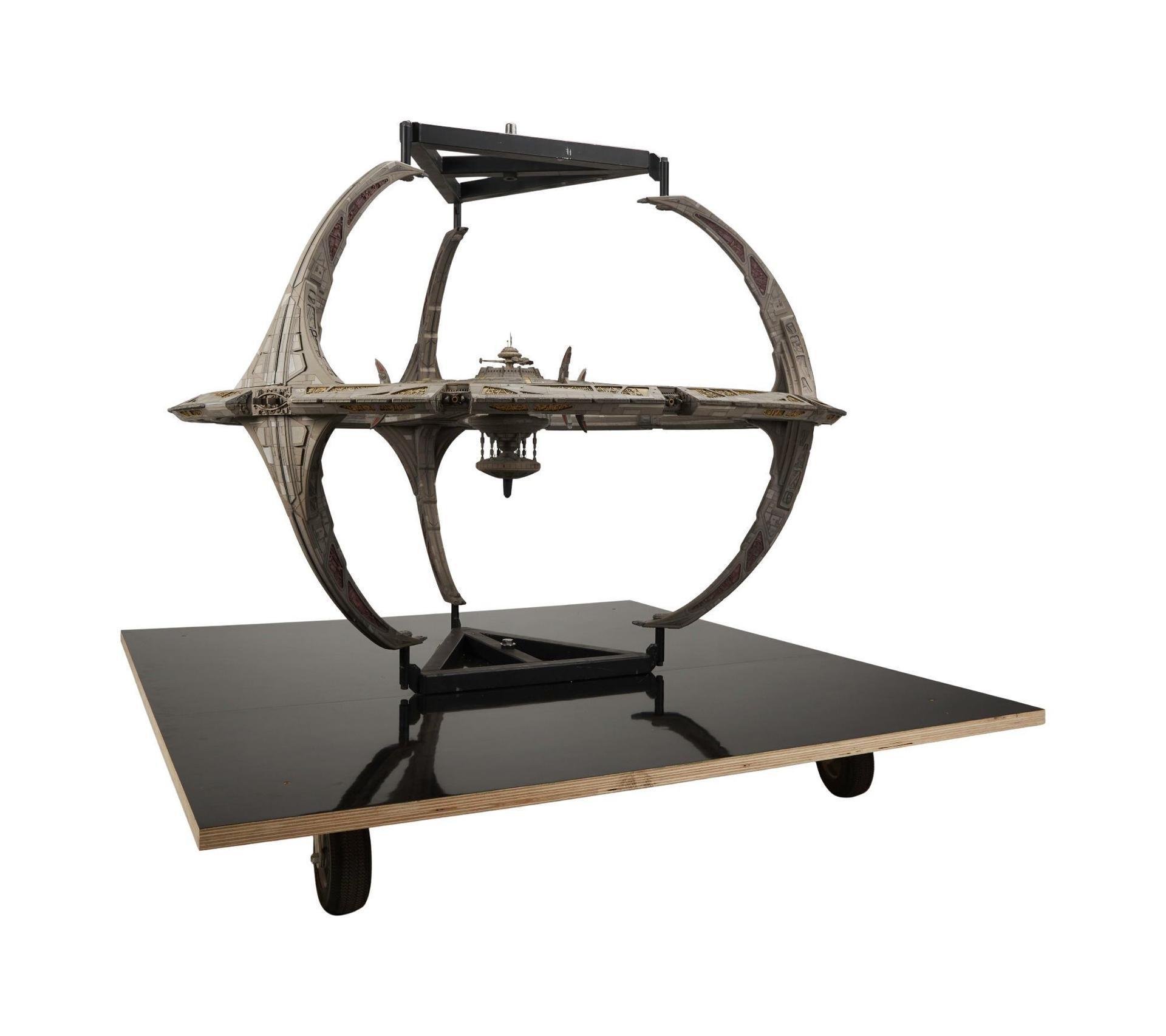
The original Deep Space Nine space station filming miniature used during the production of the television series Star Trek: Deep Space Nine (Paramount Domestic Television, 1993 - 1999).
The Deep Space Nine space station model is composed of epoxy resin and features an internal metal armature for support. The filming miniature is rigged for illumination with some of the lighted elements currently functioning.
This model can be seen in the opening credits of every episode of Star Trek: Deep Space Nine, and throughout the series. Only one shot in the final episode of the series shows the Deep Space 9 station in CGI form rather than the physical model.
The space station was designed by Production Designer Herman Zimmerman and Executive Producers Michael Piller and Rick Berman. The model's construction was overseen by Visual Effects Producer Robert Legato and Tony Meininger. More than one-thousand fiber optic strands were added to illuminate the model during production, including custom neon tubing. The model is constructed from roughly two-thousand individual pieces, and weighs about one-hundred pounds.
This model has been featured as part of numerous exhibitions, including the traveling exhibit Star Trek: Exploring New Worlds featured at the Henry Ford Museum in Dearborn, Michigan, as well as the Skirball Cultural Center in Los Angeles, California.
The model is mounted on a cart for transportation purposes. The top of the cart features a black acrylic surface and connects to the metal base mount of the space station.