Film & TV
Art
Film & TV
Art
13007 S. Western Avenue, Gardena, California 90249
Phone 310-836-1818 | Fax 310-742-0155
February 6, 2026
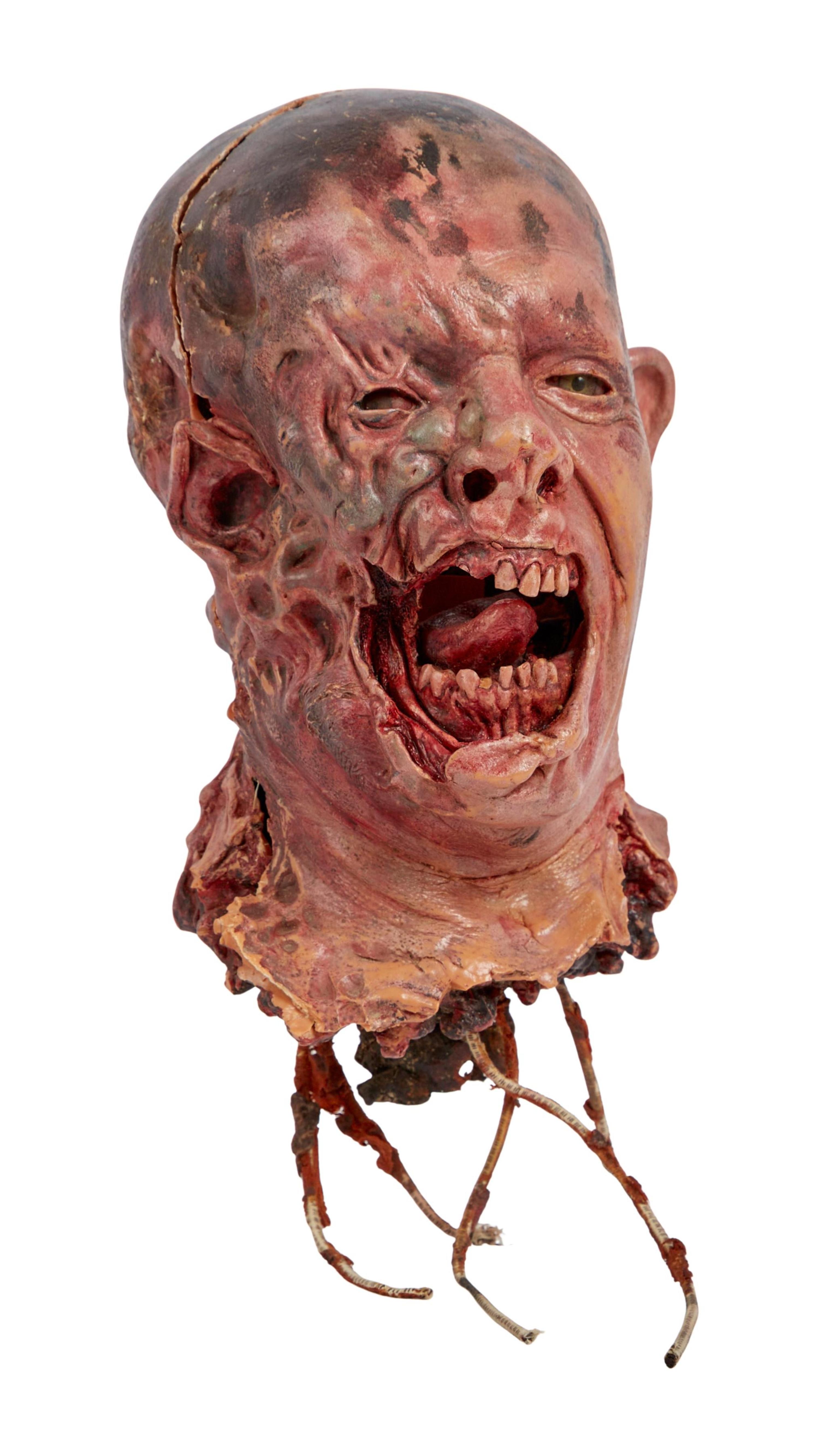
An original photo-matched production-made head prop as used in the making of the science fiction horror film The Thing (Universal Pictures, 1982).
This head prop is composed of a resin material and features extensive hand-painted detailing throughout. Faux blood and a painted burn effect are present throughout. An opening is present on the back side of the head which Dean Cundey indicates was likely because it was rigged for some sort of special effect in the production of the film.
The head is the creation of Special Effects Makeup Artist Rob Bottin, who gifted it to the film’s Director of Photography, Dean Cundey. Since the production of the film, Dean has retained the head and kept it in its original production condition.
This head prop shares some similarities to the first frozen body seen seated in a chair at the Norwegian base, as well as the right head of the charred two-headed creature seen in the snow just outside of the base. This head can be seen in an article titled "Scary Effects are his thing" featuring Rob Bottin and three of the production-made heads from the film. In the article Bottin says, "Each cell was a total organism, you couldn't kill it - you couldn't even burn it, because even the smallest speck that flew off and landed was still alive." The article continues, "Unlike your average werewolf or vampire, the Thing is not a man in a funny suit. Its many and varied parts had to be built from scratch, with skeletons made from aluminum, fiberglass or springs, realistic skin coverings and machines to make them all move. Plastic heads were made to look alive with carefully applied moisture on lips and tongues and pin lights to light up the eyes."
Dimensions: 16 x 8 x 8 inches
Category: Horror, Props, Dean Cundey
Provenance: From the Collection of Legendary Cinematographer Dean Cundey
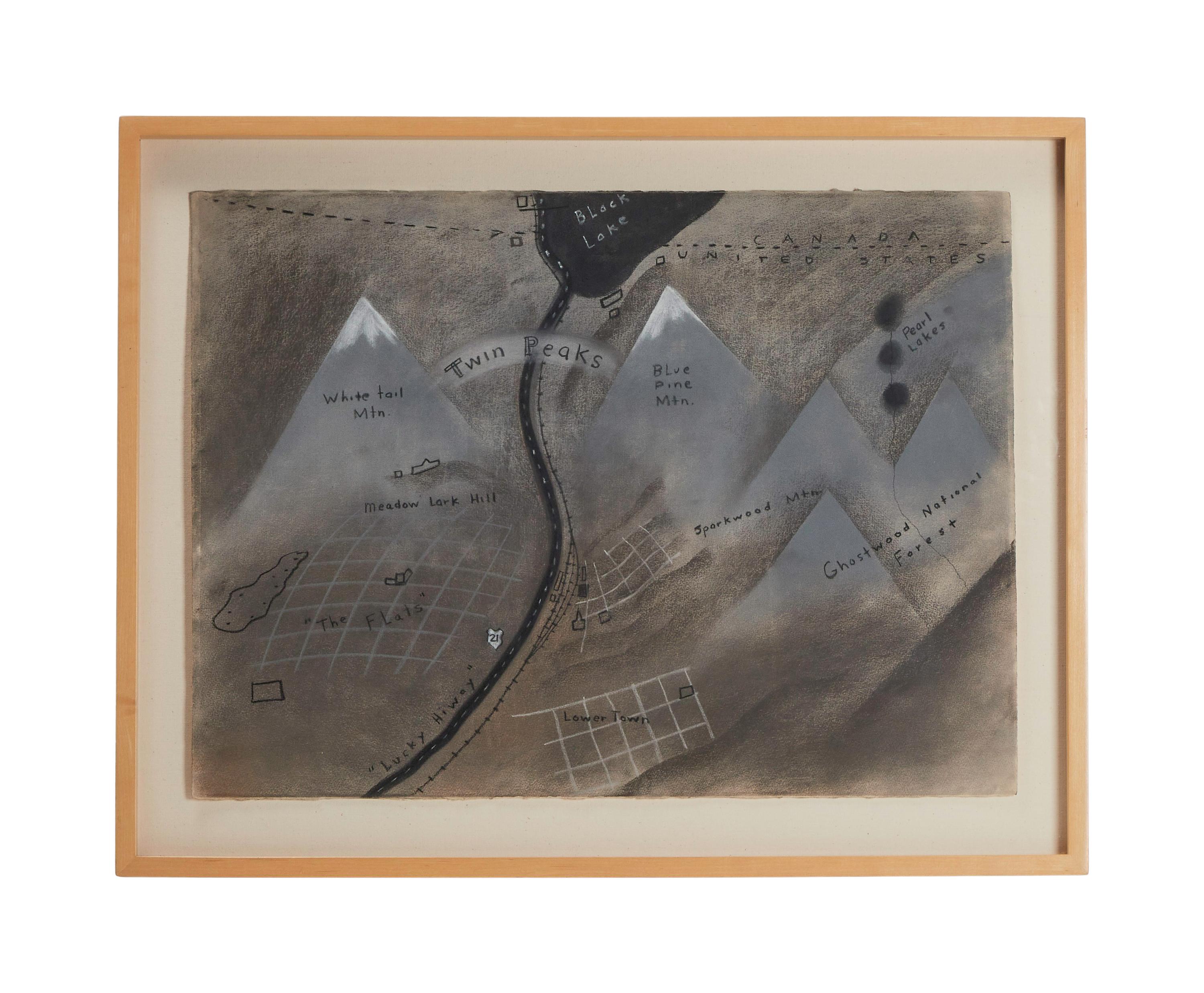
The original concept map for the town of Twin Peaks, hand-drawn and signed by series co-creator and legendary filmmaker, David Lynch. This map was used by Lynch and series co-creator, Mark Frost, to pitch their idea for the mysterious and revolutionary television show that would eventually become to be known as Twin Peaks (ABC, 1990 - 1991).
Featuring Lynch's signature artistic style, this moody original artwork illustrates the fictional surrounding area in the Pacific Northwestern part of North America where the show takes place. Lynch's unmistakable handwriting identifies the eponymous twin peaks - White Tail Mountain and Blue Pine Mountain - that the town is nestled between, as well as Meadow Lark Hill, Sparkwood Mountain, Lower Town, and "The Flats." Also identified are other significant locations to the series such as Highway 21 (labeled here as "Lucky Hiway") - which also served as the main street of the town, Ghostwood National Forest - where the entrance to the sinister and otherworldly Black Lodge resides, Pearl Lakes - where the young evil spirit of Bob first encountered a young Leland Palmer, and Black Lake - where Laura Palmer's body was found wrapped in plastic shortly after she was murdered on February 24, 1989, setting off the entire series.
The map is realized in graphite, charcoal, and watercolor on thick, textured paper with frayed edges. The piece is presented elevated against a white canvas matte and housed in a wooden frame. The verso of the frame contains an adhered label featuring Lynch's signature, handwritten date "1989 / 1990," and red fingerprint stamp.
In Nigel Holmes' 1991 book Pictorial Maps: History, Design, Ideas, Sources, he writes about this map, saying, "By creating a sense of place, Lynch made the town all the more believable. A straightforward map would have been dull by comparison and might have suggested that there was something intrinsically interesting about the geography of the place. What was much more important to convey was the mood of the story, and it's nicely captured in Lynch's quirky drawing. Not many maps... attempt to convey both a mood and data, but it can be done, and Lynch's map shows that information can be imbued with emotion and retain its factual authority."
A holy grail item that is both an incredible piece of original artwork and a behind-the-scenes look at creating one of the most groundbreaking shows in the history of television, this piece is one that will thrill and delight all Twin Peaks aficionados and any serious David Lynch collector.
Dimensions: Framed: 27.75 x 35.35 x 2 inches; Sight: 21.5 x 29.5 inches
Category: Artwork, David Lynch, Production, Twin Peaks
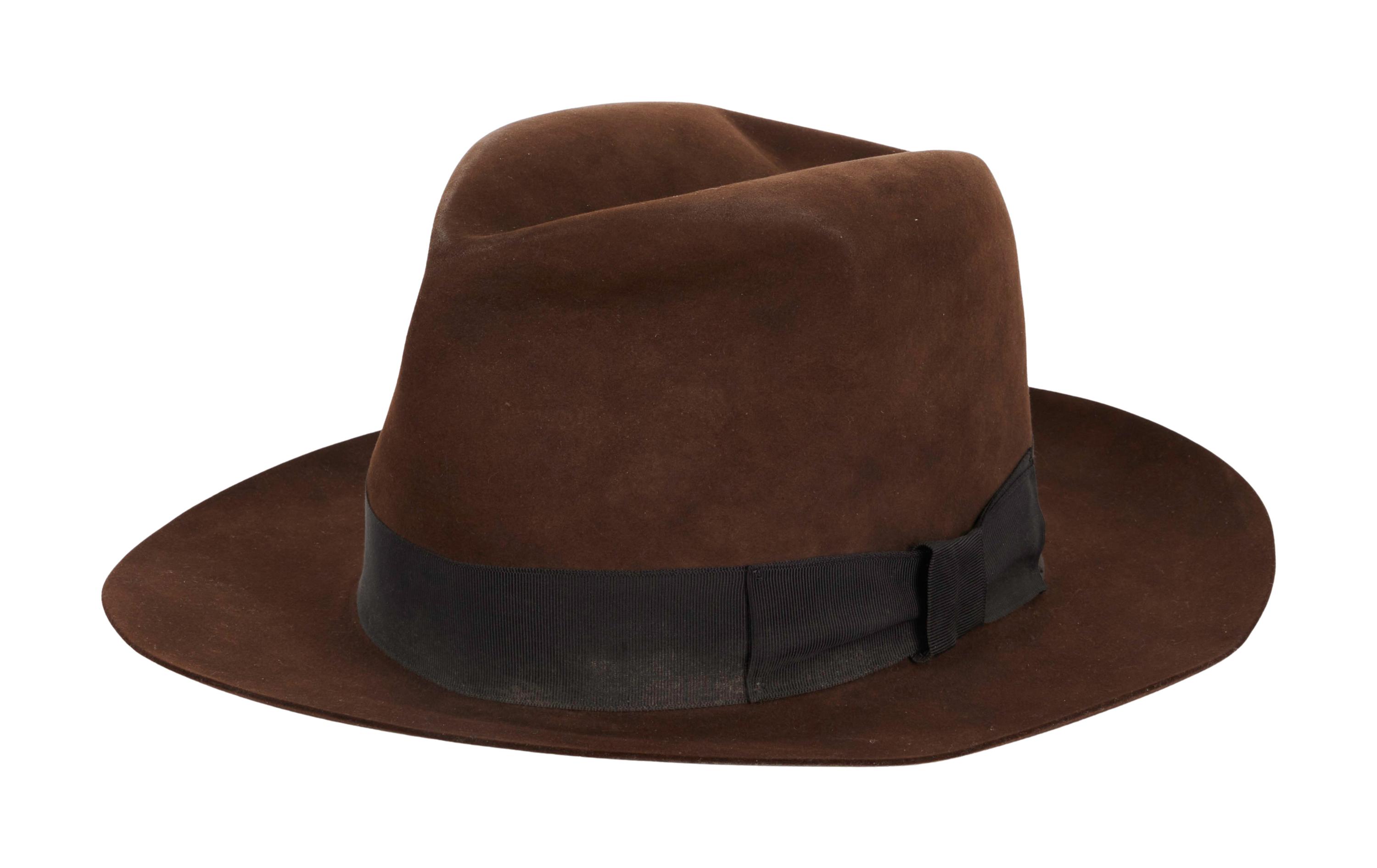
An original test fedora, used by Harrison Ford as "Indiana Jones" and signed by Harrison Ford in the production of the film Indiana Jones and the Kingdom of the Crystal Skull (Paramount Pictures, 2008).
The fedora is composed of genuine fur felt, and features a ribbon and bow around the perimeter of the crown. Inside the fedora, in gold-tone lettering, reads "Adventurebilt Hat Co./ Handmade/ Fine Fur Felt."
During the production of the film, both Harrison Ford and his costume designer Bernie Pollack selected this fedora as the one he would wear in the film. After some initial testing, Steven Spielberg decided against this fedora and selected another one in the process. This fedora is believed to have been used in the making of the scene when Indiana Jones and Mutt Williams (Shia LaBeouf) arrive in Peru and discuss Harold Oxley (John Hurt), because of its unique construction and dimensions.
The fedora is accompanied by a Certificate of Authenticity from Adventurebilt Hat Co. which reads "This Certificate of Authenticity is for an Indiana Jones Adventurebilt Fedora worn by Mr. Harrison Ford in an early costume fitting for "Indiana Jones and the Kingdom of the Crystal Skull."/ The hat is an Adventurebilt Deluxe Fedora made by me, Marc Kitter, of The Adventurebilt Hat Company in Germany. The Adventurebilt Hat Company made the hero hats worn by Mr. Harrison Ford in Paramount Picture's "Indiana Jones and the Kingdom of the Crystal Skull."/ This hat was sent to Bernie Pollack, Mr. Harrison Ford's personal costume designer, for a fitting. Mr. Harrision Ford wore the hat in the fitting but it was not ultimately used./ The hat itself is one of extreme craftsmanship. The size is between 7 1/8" and 7 1/4'. The crown is 5 1/2" tall (open crown) with a brim width of 2 7/8" x 2 5/8"./ The felt is a medium weight 100% pure beaver belly felt, some of the best in the world. The felt was also pre-distressed giving it an older and worn look."
The fedora is additionally accompanied by a Letter of Provenance from John Penman of The Penman Hat Company which reads, "Adventurebilt Hat Company was chosen to make the famous and iconic brown fedora for Harrison Ford in Indiana Jones and the Kingdom of the Crystal Skull./ We worked directly for Mr. Bernie Pollack, Harrison Ford's personal costume designer. Bernie was given the task of recreating the iconic costume, 19 years after the last Indy film./ Bernie ordered six hats for testing purposes, different measurements as there was a difference of opinion between Ford and Spielberg over the crown heights./ Adventurebilt is proud to say this fedora is one of the six test fedoras ordered by Bernie Pollack but also has a very special production history!/ Bernie had chosed this fedora, Harrison had picked it, and wore it BEFORE the film test. During the test's Speilberg picked a different one. This fedora was in their possession and had be initially chosen by Bernie and Ford./ Also Bernie and Steve had learned of a test fedora with slightly different measurements was sent by Western Costume Co. to the filming site somehow made it into the final cut of the film. It was a small oversight but can clearly be seen by a trained eye./ This fedora can be seen in the film when Indy and Mutt travel to Peru the scene when they first arrive off place and walk through street and Mutt and Indy talk on the way to find Harold Oxley at insane asylum. This fedora screen-matches up to the one Harrison Ford wears in those scenes.
The interior of the fedora features a Beckett sticker, authenticating Harrison Ford's signature present along the liner.
Category: Props, Wardrobe, Signed
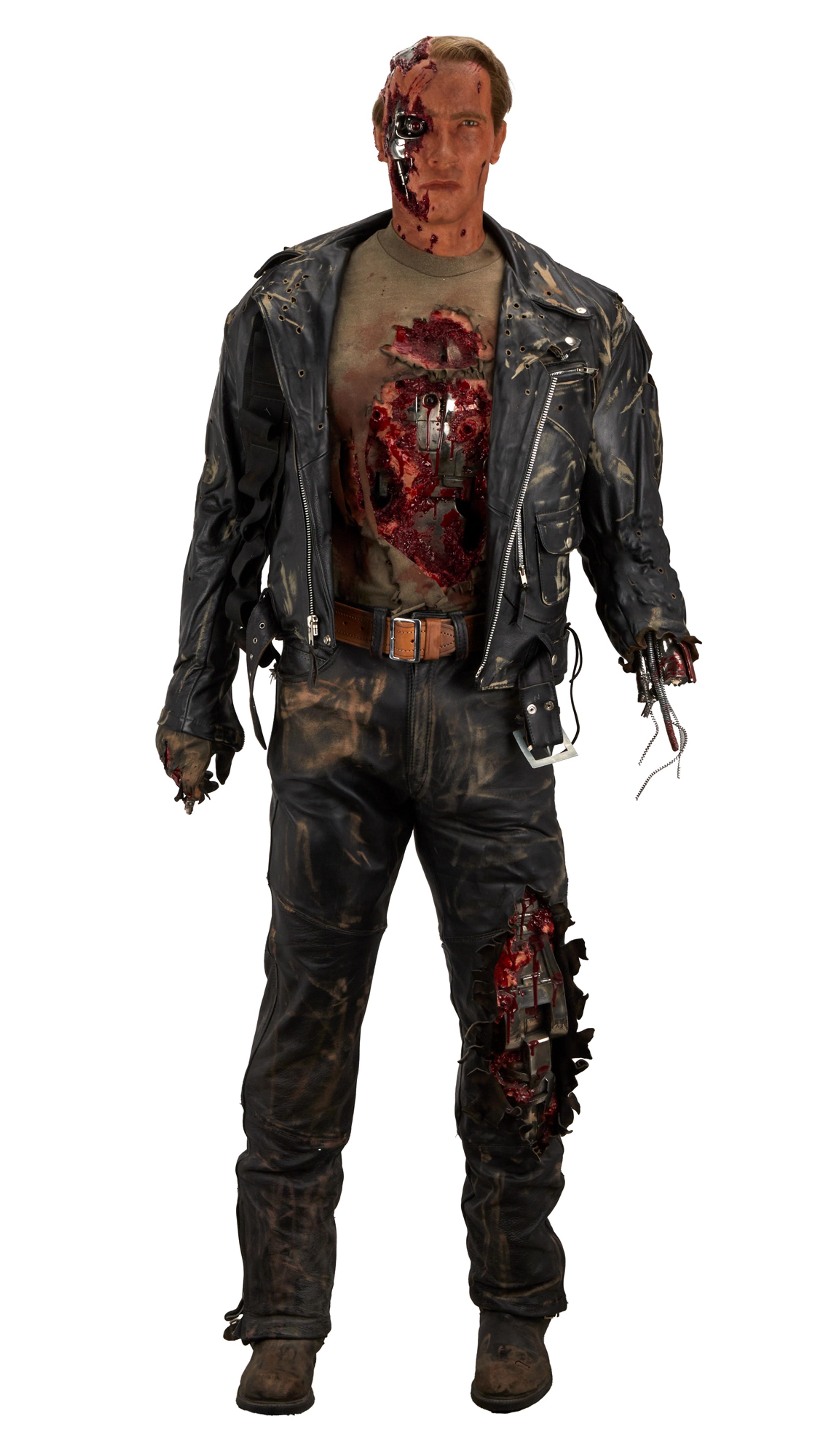
An original life-size T-800 display figure created by Stan Winston Studio as part of the Planet Hollywood Collection of Memorabilia which bears a striking resemblance to Arnold Schwarzenegger in his role as "T-800 / The Terminator" in the production of the film Terminator 2: Judgment Day (Tri-Star Pictures, 1991).
The figure is composed of resin, silicone, metal, a glass eye, and features faux knotted wig components and faux leather. The face and chest sections of the of figure feature a silicone outer layer, while the arms, legs, and torso are rigid. Elements throughout are hand-painted by the team at Stan Winston Studio. This T-800 is dressed in the iconic black leather (faux) biker jacket and jeans with boots that are of the same style that can be seen in the film. To complete the look, a replica M79 grenade launcher, which is composed of rubber and features hand-painted detailing, is included.
This figure includes a display stand and custom crate for transport and protection.
Accompanied by a Certificate of Authenticity from the "Treasures From the Planet Hollywood Collection" auction that took place March 20-24, 2024.
Dimensions: 75 x 26 x 12 inches
Category: Sci-Fi, Props
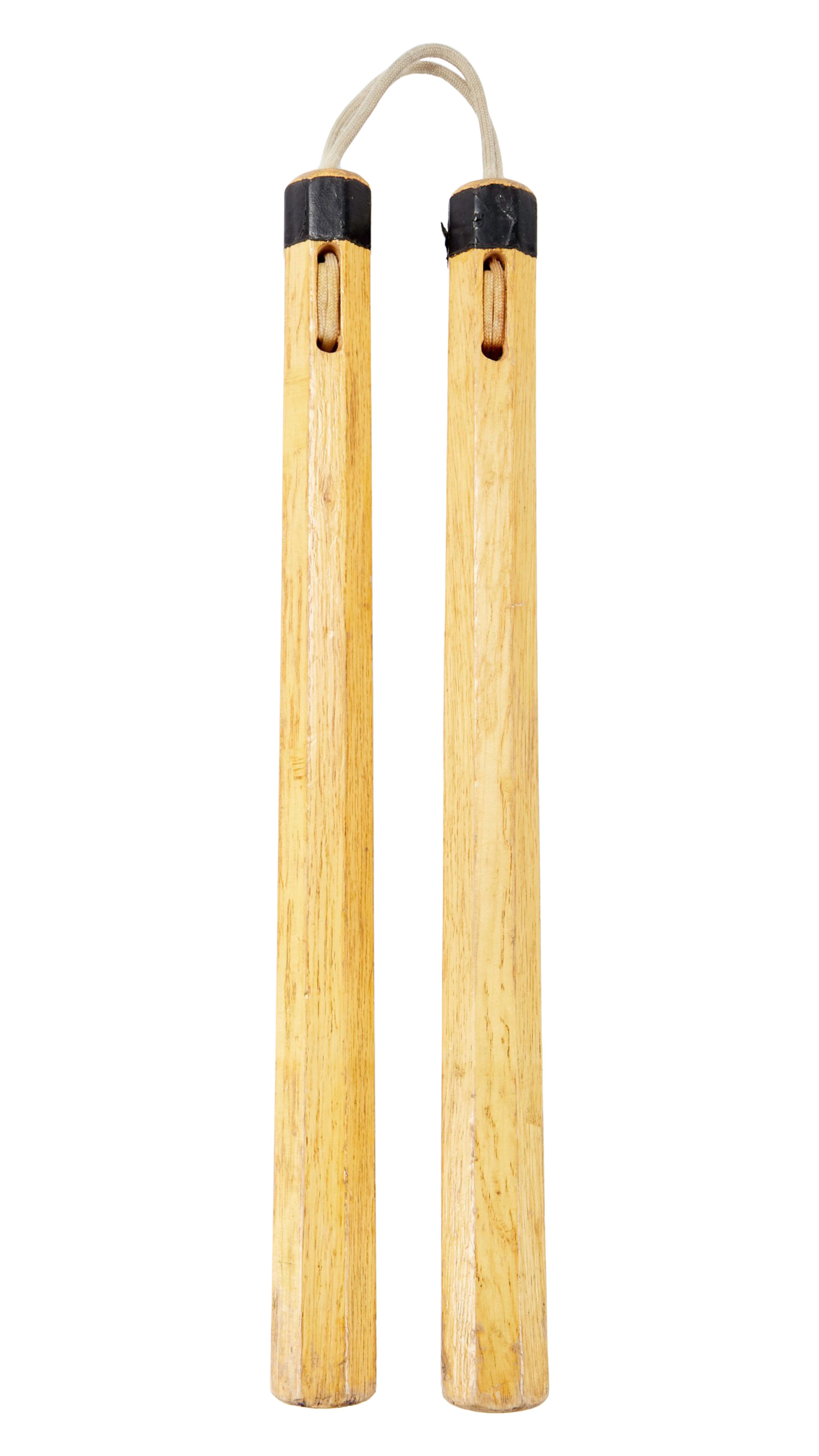
A vintage pair of octagonal-cut oak nunchaku with dual nylon cord connectors, personally owned and used by Bruce Lee.
Accompanied by a Certificate of Authenticity from Taky Kimura, dated January 23, 2013, stating:
I, Taky Kimura, state that this custom-made light wood nunchaku [aka “nunchucks”] was used and owned by Bruce Lee from the Mid Sixties until the time of his untimely death.
I certify that George Lee personally handcrafted this nunchaku in 1966 at Bruce’s request, and that he subsequently used it on countless occasions to perfect the techniques he would later display in his classic movies Fist of Fury, Way of the Dragon, Enter the Dragon and Game of Death.
Bruce preferred lightweight nunchaku to the more common heavier models, and his remarkable reflexes and hand-eye coordination enabled him to control its movement at speeds that have defied all his imitators. This much-loved nunchaku was often used for demonstrations, and Bruce was intimately familiar with its weight and size.
Over time, this iconic weapon has helped to define the extraordinary legacy, persona and image of Bruce Lee for legions of adoring fans around the world.
I verify and guarantee that this genuine pair of Bruce Lee’s light wood nunchaku is an authentic piece of Bruce Lee Memorabilia, which has been safely kept in my possession for many years. I offer this as a very important and personal piece of Bruce Lee history.
Kimura, who sadly just passed away in January 2021, was one of Lee’s top students, as well as a close friend.
Dimensions: 13.75 inches long (each chuck)
Category: Bruce Lee