Fashion
Music
Film & TV
Taylor Swift's Surprise ‘Elizabeth Taylor’ Video Drop Is a Love Letter to Hollywood Royalty
And while we're here — a look at the top Cleopatra artifacts Julien's Auctions has ever put under the hammer
Share




There's a reason Taylor Swift doesn't do anything small. So when she dropped the music video for "Elizabeth Taylor" — the third single off her twelfth album The Life of a Showgirl — on the last day of Women's History Month, without fanfare, without a press rollout, without even her own face in the frame, the internet collectively lost its mind. And honestly? It earned it.
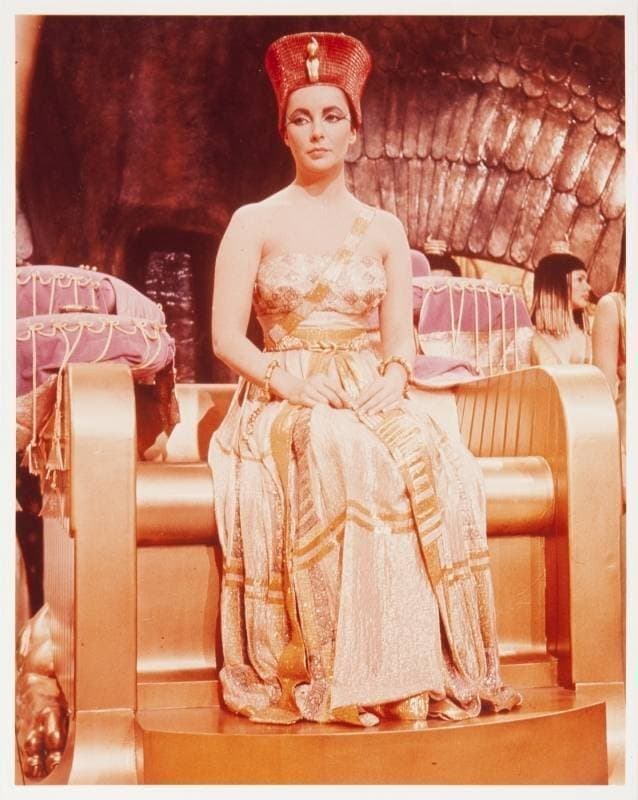
The visual, which arrived Tuesday morning, is built entirely from clips of Elizabeth Taylor's most beloved films — a sweeping mega-mix that cuts through Cat on a Hot Tin Roof, Cleopatra, Father of the Bride, Giant, A Place in the Sun, and Who's Afraid of Virginia Woolf?, among others — with Swift entirely absent from the proceedings. For a pop star who has built an empire on her own image, that choice is nothing short of radical. It's also deeply intentional.
The announcement dropped on the last day of Women's History Month, and the timing speaks volumes. This isn't a vanity project or an awards-season play. It's a genuine, full-throated tribute — and one of the most distinctive music video concepts Swift has executed in years.
The Song, The Album, The Context
"Elizabeth Taylor" is track two on The Life of a Showgirl, Swift's twelfth studio album released October 3, 2025, and it was the first song Swift wrote for the record. According to Swift, the inspiration came from an unlikely source: she had decided to write a song inspired by Taylor after watching an online video in which Taylor's son said that if he were to choose a person to compare his mother with in terms of popularity and "chaos," it would be Swift. That's the kind of serendipitous creative spark that produces something real — and it shows.
An orchestral pop and synth-pop ballad, "Elizabeth Taylor" is composed of heavy snare drums, bass, and piano, supported by electronic beats and orchestral arrangements. Critics have drawn comparisons to Reputation — and that's not an insult. Rolling Stone called it "the key to the whole record," while The New Yorker described it as depicting "power and insecurity" simultaneously, which she wrote was the central thesis of the entire album. The Guardian went further, calling it the only track on the album with a "killer chorus." High praise in a crowded field.
The lyrics themselves are a meditation on what it costs to be iconic — the loneliness that lives behind the flashbulbs, the way love and fame make for combustible, often incompatible bedfellows. That Swift drew on Elizabeth Taylor to carry that weight is, frankly, the most apt casting decision she's ever made.
A Video That Trusts Its Subject
Unlike the "Opalite" video — a full narrative production with a 1990s infomercial premise and a star-studded cast including Graham Norton, Lewis Capaldi, Cillian Murphy, and Domhnall Gleeson — the "Elizabeth Taylor" visual makes an honorary pivot. Where that video was Swift at her most playful and directorial, "Elizabeth Taylor" is Swift at her most reverential. She steps back entirely and lets the legend breathe.
The result feels less like a music video and more like a film studies thesis brought to life with a pop soundtrack.
The video is exclusively available on Apple Music and Spotify — a deliberate streaming strategy that has become Swift's new normal. By premiering on Spotify and Apple Music, whose subscription streams Billboard weighs heavily, every view of the "Elizabeth Taylor" video counts toward the song's chart position from the moment it drops — a savvy workaround in the post-YouTube chart era.

Taylor Swift Signed "Midnights" Record Album
Swift on Taylor: A Long History of Admiration
This is not a new obsession. Swift had previously channeled Elizabeth Taylor's style visually in the music video for "Wildest Dreams" in 2015 and lyrically referenced her in the 2017 single "...Ready for It?", which compared Swift's romance to that between Taylor and the Welsh actor Richard Burton. The throughline is consistent: Swift has long seen in Elizabeth Taylor a mirror — a woman who was simultaneously worshipped and picked apart, who survived scandal after scandal and kept making ambitious, polarizing work.
Swift told Jimmy Fallon she admired how Taylor responded to polarizing public opinion by taking bigger risks — "She kept making more and more daring art. It's almost like the more polarizing people were about her, the more she just kept doing even more challenging roles." Coming from a woman who has had her own very public battles with narrative control, that's not just admiration — it's identification.
Elizabeth Taylor’s Legacy at Julien’s
Elizabeth Taylor's artifacts have always played in a different league entirely — one where cinematic history, couture craftsmanship, and the mythology of Old Hollywood converge to produce results that routinely blow past even the most optimistic estimates.
In the spirit of Swift's tribute, here's a look at the top three Cleopatra artifacts Julien's has ever put under the hammer — pieces that connect directly to the film at the heart of the video's most iconic sequences and defined an era.
The Snake Cuff Bracelet — Joseff of Hollywood: Treasures from the Vault (2017)
Estimate: $5,000–$7,000 | Sold: $21,875

This is the piece that collectors still talk about. A gold-plated cuff bracelet executed in Joseff of Hollywood's signature Russian plating technique — a process that creates a warm, matte finish specifically designed to photograph beautifully under the harsh studio lighting of the Golden Age — with hammered texture and six snake accents rendered in relief. It's a stunning object on its own terms. That Elizabeth Taylor wore it in Cleopatra makes it something else entirely.
The result? More than four times the high estimate. That gap between expectation and reality tells you everything you need to know about the enduring market for Cleopatra pieces. When the film was made in 1963, it was the most expensive movie ever produced. The artifacts it left behind have lost none of that weight.
The Lotus Blossom Bangle — Icons and Idols 2013: Hollywood Auction
Estimate: $1,000–$2,000 | Sold: $14,080


This one nearly defies categorization — a gold-tone metal bangle with ribbing and raised details, painted scarlet red bands, five dangling lotus blossoms on chain, and beaded fringe, with a clasp opening. It's elaborate, theatrical, unmistakably Egyptian in its visual language. Taylor wears the same or similar bangle across multiple scenes in the film, which gives it a screen presence that single-appearance pieces simply can't match.
The provenance here is exceptional. The bracelet had been previously exhibited at the Dutch National Museum of Antiquities in Leiden as part of "Hollywood's Egypt," a traveling exhibition that ran from October 2012 through March 2013 — meaning this object had already been recognized as a cultural artifact before it ever hit the auction block. It sold for more than seven times its low estimate. The bracelet was also the recipient of the costume design legacy that accompanied Cleopatra's Academy Award for Best Color Costume Design, awarded to Renie, Vittorio Nino Novarese, and Irene Sharaff at the 36th Annual Academy Awards.
The Falcon Headdress — Icons and Idols 2013: Hollywood Auction
Estimate: $2,000–$3,000 | Sold: $12,800


Perhaps the most extraordinary of the three — and the most poignant. This falcon headdress, in which the bird cradles the crown of Taylor's head between its wings, is composed of golden hand-etched and painted leather feathers with gold wire spines, embellished with opalescent plastic layered beneath the feathers and jet-like teardrop beads between them. The craftsmanship is breathtaking.
Here's the twist: the scenes in which Taylor wore this piece never made it into the final cut of the film. Which means this headdress exists in a kind of cinematic limbo — designed for a queen, worn by the most famous woman in the world, and yet never seen by the audiences who packed theaters in 1963. It's a ghost of a performance, documented only in the two black-and-white studio images that accompanied the lot. Like the bangle, it had also been exhibited in Leiden.
That it still sold at more than four times its low estimate speaks to a truth the market has understood for decades: with Elizabeth Taylor, the story is always enough.
The Larger Picture
Swift's video and Julien's catalogue history share the same conviction — that Elizabeth Taylor matters, that her art and her artifacts are worth preserving, worth celebrating, worth spending real money on. The woman who became the first actor in history to receive a $1 million salary for a single film, who won two Academy Awards for Best Actress and starred in films including National Velvet, Giant, Cat on a Hot Tin Roof, and Who's Afraid of Virginia Woolf? did not shrink under the weight of her own legend. She expanded to fill it.
Swift appears to understand that. And somewhere, in an archive, in a museum collection, in a private display case Elizabeth Taylor’s artifacts are still doing the same thing they always did: making the queen visible.