Reviled as they might be, rats have been an indelible part of human civilization for as long as it’s been around. When the first humans banded together in proto-cities on the banks of the Efrat and Tigris thousands of years ago, they were there. Indeed, ever since we first started storing grain, rats have been symbiotic with humans, thriving off the shelter and abundant food sources we provide.
Naturally, this constant companion of man has come to symbolize various things, spurring a plethora of myths and meanings. Sneaky and nocturnal, the rat represents our society’s seedy underbelly, the hidden darkness and chaos that inevitably comes with order and organization. Their role in spreading disease (most notably the bubonic plague) has kept rats unpopular, however they still have their admirers among the populace, who find meaning and inspiration in the rodents’ resilience and resourcefulness.
ART RATS
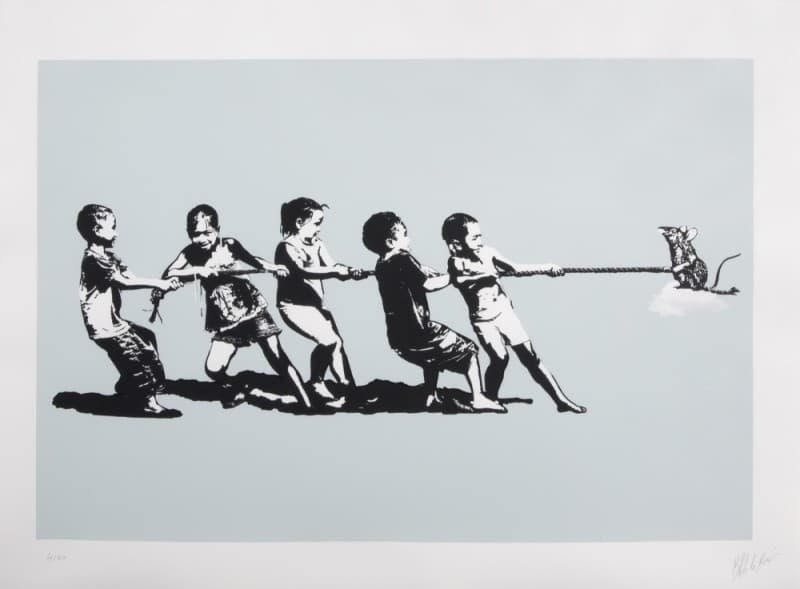
The advent of graffiti and street art since the 1980s has seen rats play a more prominent role in the arts and symbolism than ever before. This can be traced to French street art pioneer Blek Le Rat (born Xavier Prou in 1951), who is often referred to as “the godfather of street art” and was the progenitor of stencil graffiti, a style that UK street art legend Banksy later adopted and put to good use.
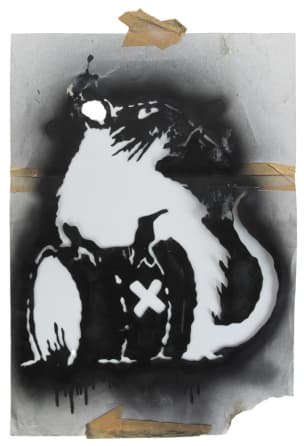
1. BLEK LE RAT: SIGNED LIMITED EDITION "ROPE PULLING" PRINT, 2. BANKSY: ORIGINAL "TOXIC RAT" STENCIL (reverse),
Blek was exposed to the then rising art of street graffiti on a visit to New York, and upon returning home adapted it to Paris architecture by incorporating stencils, which he felt fit the city’s urban landscapes better (and helped him make faster work). True to his adopted moniker, Blek Le Rat’s initial subjects were rats, which he has described as “the only free animal in the city,” while noting that rats spread plague everywhere, much like street art can spread uncomfortable or unpopular ideas. Furthering on the theme, Blek has remarked that he finds something ratty about an artist sneaking around, doing his work under cover of darkness. In a 2012 interview looking back on his career, he told The Independent that he wanted to say to Parisians: “Your city is very beautiful, but don't forget that your basements are full of vermin.”
Le Rat’s stenciled street art went on to inspire a generation of artists that found resonance in his style, humor and subject matter. Most notable of those is the undisputed current king of street art, the elusive yet ever present Banksy, who has made a million dollar industry out of his scathing, politicized and heavily satirical stencil work.
A POTENT SYMBOL
Coming out of the vibrant Bristol, UK, scene in the early ‘90s, Banksy rose to prominence upon relocating to London, where he engaged in a guerrilla campaign of thought provoking artwork, leaving his mark on the city wherever he could. He quickly drew international attention—aside from appearing in galleries and museums the world round, his work may be found in a plethora of cities on almost every continent, from Gothenburg to the Gaza Strip.
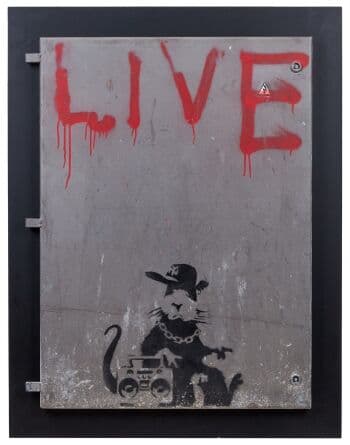
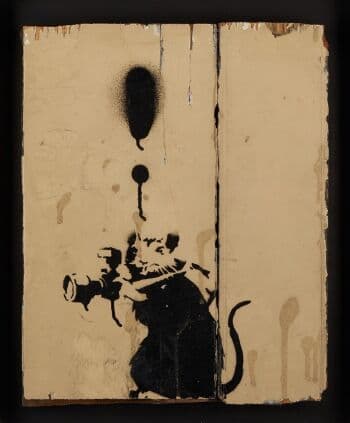
Best described as anti-war, anti-capitalist and anti establishment, Banksy’s subject matters are wide ranging but always thought provoking. And, since the beginning, it has featured rats prominently. To Banksy, the rat appears a potent symbol for whatever he is trying to convey at the time and his emphasis on uncomfortable truths; whether depicting a rat holding up a sign or groups of them engaging in eerily human-like behavior, the message is hard to miss and always on point.
Unsurprisingly, Banksy’s use of stencils along with his frequent depictions of rats often draw comparisons to Blek Le Rat’s work. In the few interviews he has given, Banksy is vocal about Blek’s influence on his career, frequently citing him as a key inspiration. Blek Le Rat has in turn expressed his appreciation for Banksy’s work and gratitude that his success in galleries and auctions has put the spotlight firmly on street art and its status as a high-class art.