History
Music
Art
Bob Dylan & the Pop Music Royalty of 1968: A Story with a Price Tag
An in-depth look at the 1968 pop music scene featuring Bob Dylan and other icons, revealed through a recently unearthed expense report up for bid in Julien's Auctions "Celebrating Bob Dylan: The Aronowitz Archive, T Bone Burnett, & More" auction. Register and bid now.
Share



The November 2nd, 1968 issue of “The Saturday Evening Post” offered readers a glimpse into the vibrant world of pop music with a cover story boldly proclaiming "Bob Dylan and the Pop Scene." While the magazine, known for its pictorial features, leaned heavily on striking images, the accompanying text provided a fascinating snapshot of a musical landscape on the cusp of transformation. But the story behind the story, revealed through a recently unearthed expense report, adds another layer of intrigue to this iconic piece of music journalism.
The article, titled "Pop: The Royal Family," opened with a series of portraits featuring three icons who would tragically become members of the "27 Club": Jim Morrison of The Doors, Jimi Hendrix, and Janis Joplin. This somber foreshadowing, though unintentional, served as a stark reminder of the era's excesses and the fragility of genius.
The "royal family" showcased within the article's pages spanned a diverse range of genres, reflecting the eclecticism of the late 1960s music scene. Janis Joplin shared the spotlight with country music legend Buck Owens, avant-garde rocker Frank Zappa, anti-war activist Country Joe McDonald, bluesman B.B. King, and folk singer Arlo Guthrie. Further pages featured Grace Slick and the Jefferson Airplane alongside The Fugs, Aretha Franklin, Ravi Shankar, Dionne Warwick, Tiny Tim, Al Kooper, Otis Redding, Merle Haggard, Mavis Staples, and the Beach Boys. The visual feast continued with images of Ritchie Havens, Diana Ross, Charles Lloyd, Ray Charles, Johnny Cash, Elvis Presley, Simon and Garfunkel, the Beatles, Herb Alpert, and The Rolling Stones. This impressive roster highlighted the era's musical breadth and the blurring of lines between genres.
The King and His Court
At the center of this musical kingdom stood Bob Dylan, captured in a striking black and white photo, guitar in hand, with a caption declaring him "The King." The accompanying article delved into Dylan's retreat to Woodstock, New York, following his controversial motorcycle accident in 1966. It was during this period of seclusion that Dylan, along with Robbie Robertson and other members of The Band, immersed themselves in a creative haven, a house known as "Big Pink." This period of withdrawal proved to be a pivotal moment in Dylan's career, allowing him to recharge and redefine his artistic direction.
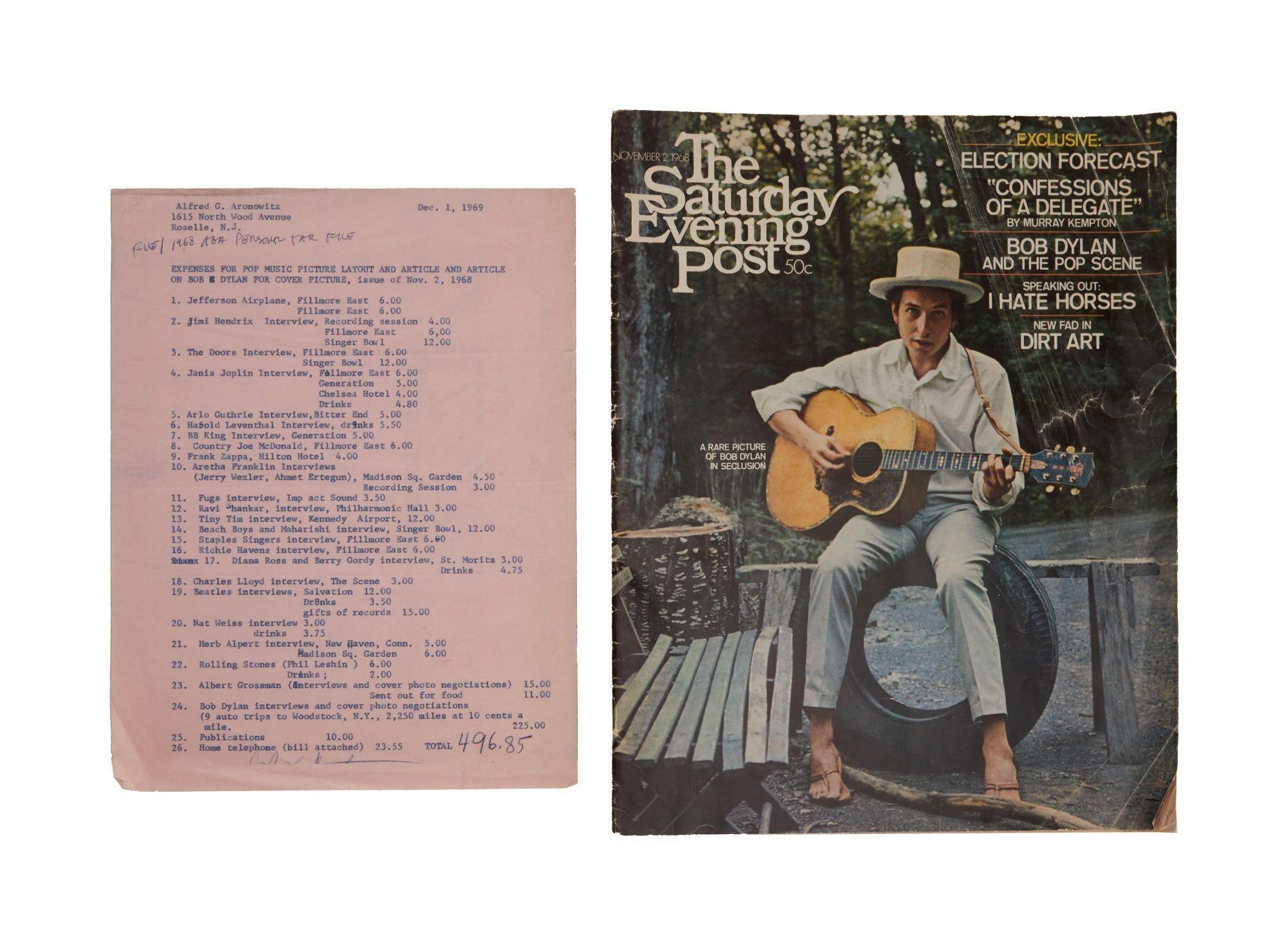
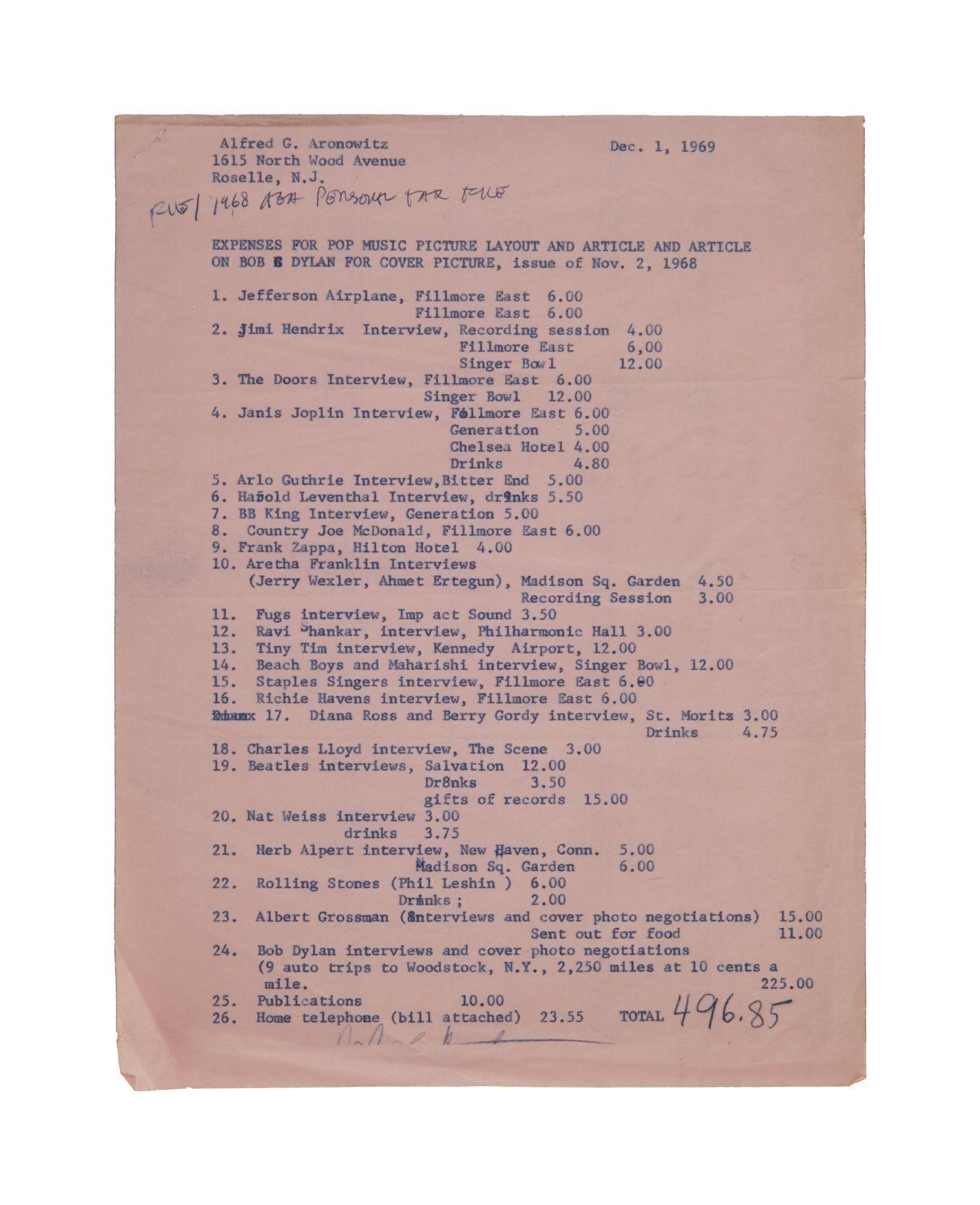
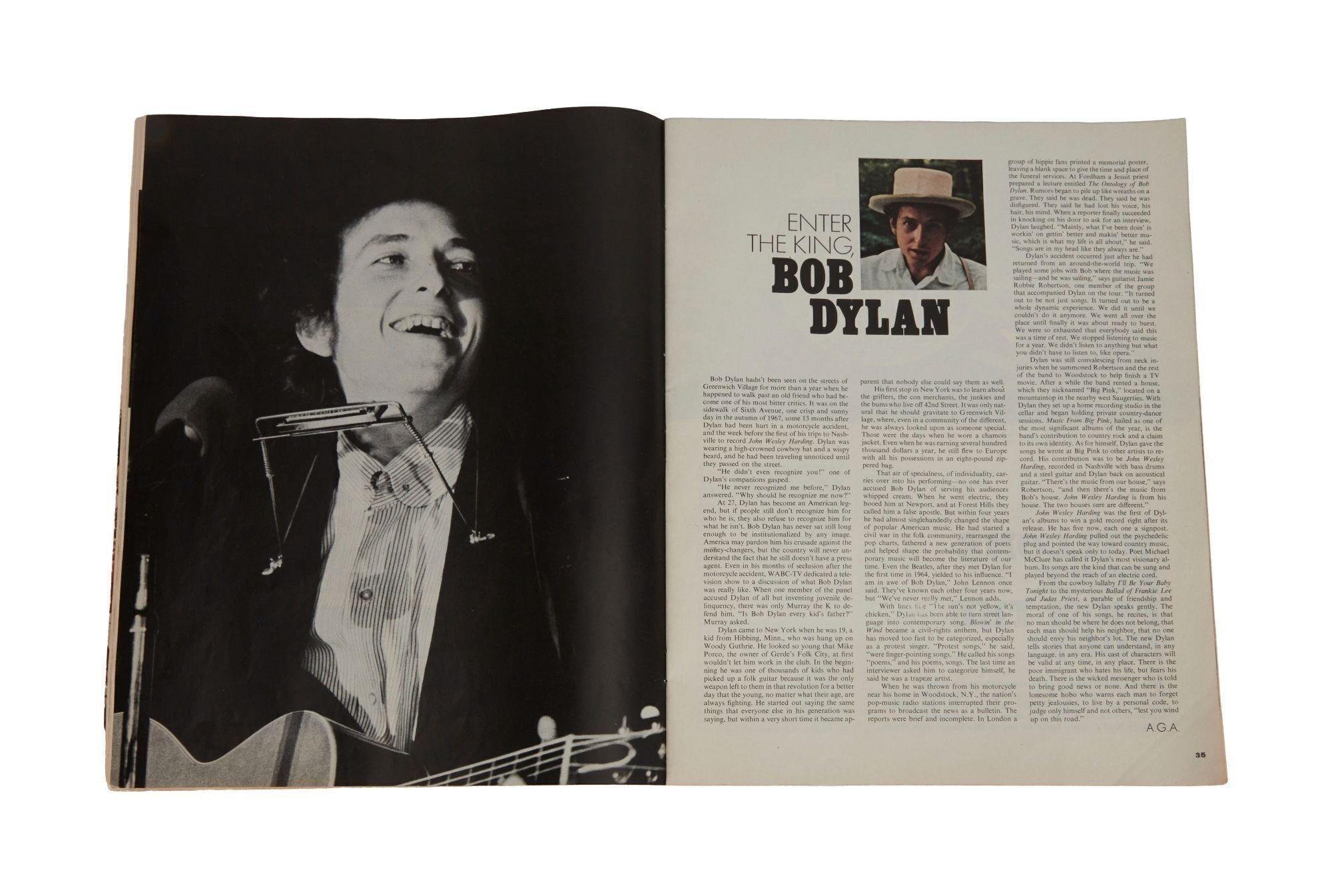
1. Lot #34. Bob Dylan | 1968 Saturday Evening Post With Aronowitz Expense Report,
The article emphasized Dylan's profound influence on the music scene. Quoting music critic Al Aronowitz, it stated, "He had started a civil war in the folk community, rearranged the pop charts, fathered a new generation of poets and helped shape the probability that contemporary music will become the literature of our time. Even the Beatles, after they met Dylan for the first time in 1964, yielded to his influence." This powerful statement solidified Dylan's position as a leading force in shaping the sounds and sensibilities of the era.
The Expense of Exclusivity
And it's here that the recently uncovered expense report of Al Aronowitz himself provides a fascinating glimpse behind the scenes of this iconic article. Dated December 1, 1969, the report details Aronowitz's expenses incurred while interviewing a who's who of music royalty for the piece, including The Beatles, Jimi Hendrix, B.B. King, Jefferson Airplane, and of course, Bob Dylan. The report lists expenses such as "$15 for 'gifts of records'" and "9 auto trips to Woodstock, New York" for Dylan, culminating in a grand total of $496.85. This document offers a tangible connection to the era and the efforts involved in capturing this pivotal moment in music history.
Ironically, the following summer saw the legendary Woodstock festival take place just a stone's throw from Dylan's retreat. While the festival became a defining moment for the counter-culture generation and launched the careers of many musicians, Dylan himself chose to remain on the sidelines. He opted instead to perform at the Isle of Wight Festival, further solidifying his image as an artist who followed his own path, even if it meant diverging from the mainstream.
Celebrating Bob Dylan: The Aronowitz Archive - An Auction
In retrospect, the “Saturday Evening Post” article provides a captivating time capsule of a pivotal moment in music history. It captures the energy and diversity of the late 1960s pop scene, while also highlighting the unique and enduring influence of Bob Dylan, the enigmatic "King" who reigned over this musical kingdom. And now, with the emergence of Aronowitz's expense report, music enthusiasts and history buffs alike have a chance to own a piece of this story.
The report is set to be auctioned off on January 18th at 10:00 AM CST in Nashville as part of the "Celebrating Bob Dylan: The Aronowitz Archive, T Bone Burnett, & More" auction. Register and bid now. This is a rare opportunity to acquire a tangible piece of music history and connect with the legacy of Bob Dylan and the era that defined him.