Art
Alberto Vargas: How the King of Pin-Up Art Immortalized the American Girl
From the mountains of Peru to the pages of Playboy...
Share




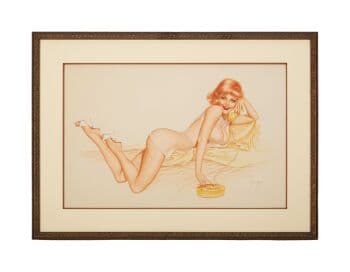
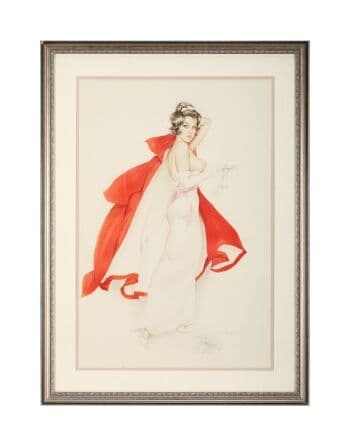
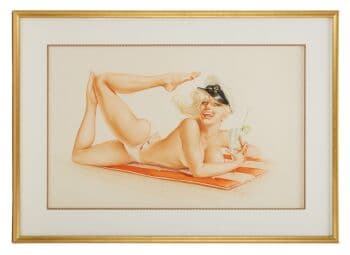
PLAYBOY | ALBERTO VARGAS GIRL PINUP MAY 1968 WATERCOLOR DRAWING
Love. Artist Alberto Vargas was a man driven by love, first and foremost. A glance at any of the masterful paintings and illustrations he produced throughout his long, storied career confirms this. The care with which he renders the subjects of his stunning portraits, the attention to detail, the respect for form and the idealistic interpretations that all manifest his loving desire to— as he described it — “immortalize the American girl.”
Known as “the king of pin-up art”, Alberto Vargas had a remarkable career that took him from the Andes mountains of Peru through the cultural hubs of Europe before settling in the United States, where he created a legacy that would shape and reflect the ideals of American beauty in the 20th century.
NUDES VS. LEWDS
Born in 1896 in the mountain city of Arequipa, Joaquin Alberto Vargas y Chavez was the oldest of six siblings. His father, internationally renowned photographer Max Vargas, quickly recognized the boy’s keen eye and took care to nurture young Alberto’s gift. Growing up, he spent countless hours assisting his father in the studio, learning the fundamentals of photography, composition, processing and airbrushing.
In 1911, Vargas sailed to Europe, where he was to attend an elite school in Switzerland and apprentice at a photo studio. While in Switzerland, he made frequent trips to Paris to revel in the museums and galleries, taking in the works of the great masters and finding inspiration for his own budding artistry. In 1916, as the continent became swept up in the lead-in to the first World War, Max Vargas sent for his son, who was to take the first boat back home to Peru. The boat made a fateful stop in New York City, where Alberto found himself in love with the bustling metropolis and, especially, its womenfolk.
"I had never seen anything like it,” he later remarked. “Hundreds of girls with an air of self-assuredness and determination that said, 'Here I am, how do you like me?' This certainly was not the Spanish, Swiss or French girl!” Fascinated by the young nation, the manifold opportunities it presented, and its women, the young artist decided to stay in the U.S.
FINDING LOVE
Vargas quickly put his artistic skills to use, finding work doing freelance illustrations and drawings for various publications and advertisers. Working primarily in watercolor and airbrush, he got a steady job drawing Florenz Ziegfield’s follies girls, where he further honed his craft and style on a steady paycheck through the twenties. ''I learned from Ziegfeld the difference between nudes and lewds,'' he said. ''The drawings are a thing of beauty.''
However, it was with Ziegfield’s main competitor, the Greenwich Village follies, where Vargas found his muse. Strawberry blonde Tennessee transplant Anna Mae Clift became the object of Vargas’ fascination; a regular model, inspiration and, eventually, his wife. The two were inseparable until death did them part, and Anna Mae proved to be an important part of Vargas’ career — aside from providing a loving home and steady inspiration, she guarded his interests closely, handling his business affairs and supporting him through tough times.
After getting married in 1930, the couple relocated to Los Angeles, where Vargas found work with 20th Century Fox and Warner Brothers, designing sets, painting posters and doing now immortal portraits of stars like Greta Garbo, Anna Sheridan, Marlene Dietrich, Ava Gardner, Jane Russell and even Shirley Temple. After several years of good fortune in Hollywood, Vargas lost his job after participating in a union walkout with several of his colleagues, effectively blackballed by the studios as a rabble-rouser and communist sympathizer.
THE VARGAS GIRLS GO TO WAR
Returning to New York to seek work, Vargas was quickly snapped up by Esquire magazine, who needed a replacement for their in-house artist George Petty, who was celebrated for his monthly installment of “Petty Girls”. Vargas was tasked with continuing the tradition, resulting in the so-called “Vargas Girls,” which Esquire immediately made its defining emblem.
The Vargas Girls were an instant hit for Esquire, who capitalized on their success by releasing Vargas girl calendars and merchandise, pushing Vargas to expedite his process and produce paintings at a near-infeasible rate. Starting in 1940, the leggy, seductive Vargas Girls were everywhere, especially popular with U.S. troops deployed in World War Two. His iconic renderings of stars such as Betty Grable were found on the side of bomber planes, tattooed on the arms of GIs as well as in their lockers. The Vargas Girl became synonymous with the stateside war effort, later said to be “as important as Glenn Miller and Victory Bonds.”
Between 1940 and 1946, Vargas completed 180 paintings for Esquire. This was without doubt the pinnacle of the artist’s career. Vargas’ work was everywhere. Esquire was making millions selling Vargas Girl calendars, posters and merchandise. Yet Vargas himself saw relatively little compensation for his hard work, having signed a treacherous contract with Esquire at the beginning. Once Vargas and his wife realized this, his relationship with the magazine soured. A years-long legal battle ensued, which among other things saw Esquire copyright claims blocking Vargas from using his own name in his artistic endeavors.
REVERSAL OF FORTUNE
The couple struggled financially after years of litigation and trouble, but in 1959 they saw yet another reversal of fortune, when Playboy magazine drafted him to return to the scene. The Vargas girls returned to the media scene, with monthly installments in Playboy, with Vargas’ career flourishing, resulting in several major exhibitions all over the world.
Devastated by the death of his wife in 1974, Vargas stopped painting, briefly returning to the scene in 1978 following the release of his biography. From then on until his own death in 1982, he produced several celebrated artworks, although it is said he never really recovered from losing his muse and lifelong partner.